
Course → 1.5 Agents and Parallel Work
Lesson 1.5 of the Free Claude Cowork Course · 20 minutes
Overview
Split one productization question into three independent research tracks, review their findings separately, then synthesize a traceable recommendation. Run tracks concurrently when the environment supports it; otherwise use clearly separated sequential tracks and say so. Client-stated outcomes and fictional estimates must retain those labels in both tracks and memo.
What You’ll Do
✓
Decompose three independent research tracks and run them concurrently where supported
✓
Learn which tasks parallelize well and which need your attention serially
✓
Practice the review pass: checking parallel outputs efficiently
The Lesson
Say “start lesson 1.5” with the course folder open. Read scenarios/research-brief/brief.md. Research the Ferrostar engagement, the two fictional competitors and the fictional industry signals into three separate track files. Review every track before writing recommendation-memo.md from those files only: one recommendation, three reasons, biggest risk, one page. Trace a claim from memo to track to original source, preserving uncertainty labels at both steps.
Try It Now
List this week’s pending tasks and mark which are independent enough to run in parallel. Pick two and run them together. That’s the end of Module 1 — Module 2 connects Cowork to your real tools and your team.
Follow the exercise: decompose, research, review, synthesize
Follow a real Lesson 1.5 run in Claude Desktop using the synthetic Alex course folder restored after Lessons 1.1–1.4. Native lossless PNGs are cropped without resampling and annotated with red primary and yellow supporting highlights. App labels and layout can vary by version and plan. Open any image at full size to inspect the text.
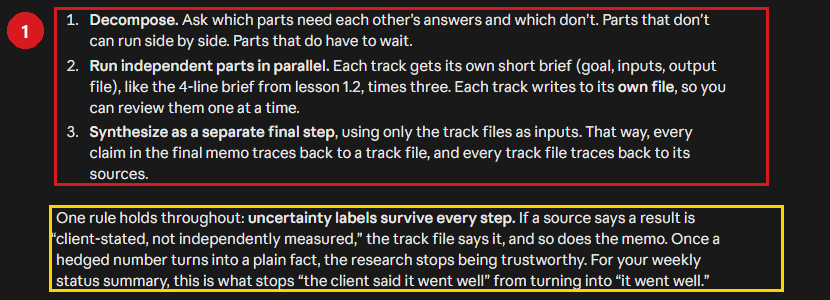
1. Separate independent research from synthesis
Identify which tasks need another task's answer. Give independent tracks separate briefs and files, review them individually, and synthesize only afterward. Preserve uncertainty labels through every step.
2. Verify actual execution and separate outputs
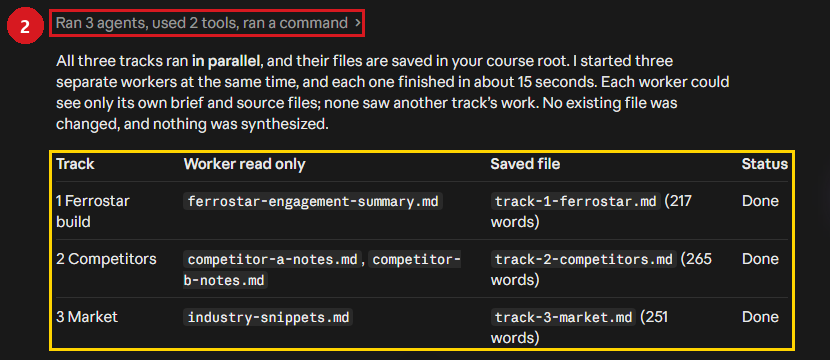
This run's activity summary shows three agents, and the completion table lists each track's own source and saved file. Concurrent execution depends on the available environment. The approximately 15-second timing is Claude-reported, not independently measured.
3. Review the engagement evidence and its limits
Open the actual saved Ferrostar track. The roughly 120 versus 1,400 weekly alarms result remains client-stated, not independently measured. The roughly 70% reusable figure also keeps its approximation and missing-method caveat.

4. Review the competitors' evidence limits
Open the saved competitor findings. Both competitors are fictional. SentinelOps' notes give no underlying provenance, and PlantPulse's no-triage claim rests on only two user reviews. Carry those limits into any recommendation instead of presenting the claims as independently verified market facts.
Present the existing track-2-competitors.md in the native viewer without changing it. Check the fictional labels, missing provenance for Competitor A, and the two-user-review basis for PlantPulse's claim. Do not synthesize yet.
5. Correct interpretations before synthesis
Compare Track 3 with its source. In this run, review removed an unsupported statement about the remaining survey and an interpretation about platform packaging. The revised file retains the weak, anecdotal buying note and labels the roughly 14,000 US plants figure a fictional estimate for course purposes. A count of plants is not a count of buyers.
Review track-3-market.md against industry-snippets.md. Remove unsupported interpretations from findings, preserve the source citations and fictional estimate label, then show the actual saved revised file. Do not synthesize yet.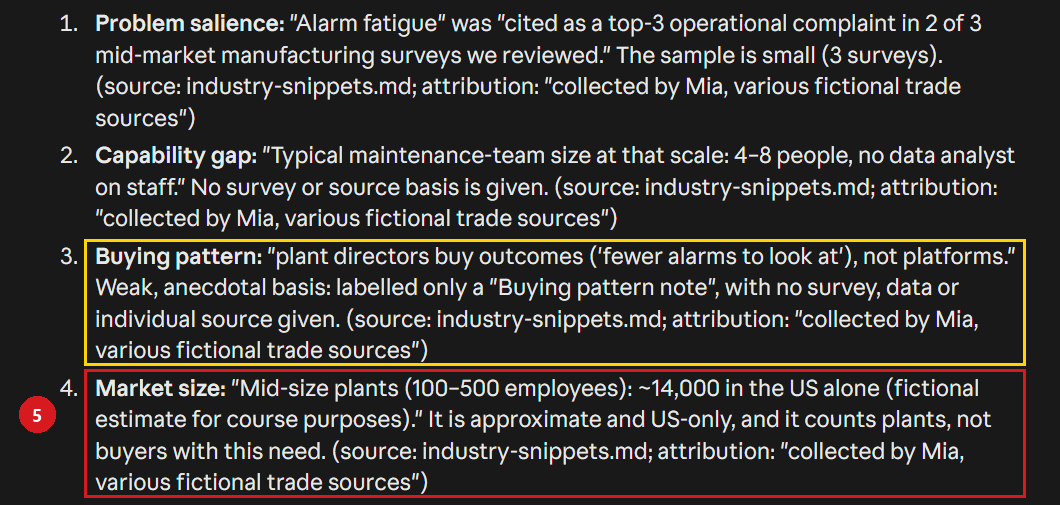
6. Synthesize only after reviewing all three tracks
The actual saved 484-word memo uses the three reviewed track files as its only inputs. It gives one recommendation, three reasons and the biggest risk. Evidence cites a track file; the recommendation and reasoning are explicitly marked as inference. The proposed managed service starts with validation and a second pilot, rather than assuming the fictional evidence proves a market.
From the three reviewed track files only, write recommendation-memo.md: one recommendation, three reasons, biggest risk, one page. Every factual claim cites its track file. Keep all uncertainty labels and distinguish evidence from inference.
7. Trace claims from memo to track to source
Review the saved memo, then open the cited track and its original source. The alarm counts trace through track-1-ferrostar.md to ferrostar-engagement-summary.md and remain client-stated, not independently measured. The US plant count traces through track-3-market.md to industry-snippets.md and remains a fictional estimate for course purposes. Both qualifications survived both hops; the memo does not replace them with a measured percentage or a proven market size.

8. Complete the quiz and save the Part 1 milestone
Answer the three questions individually: which tasks are independent, why separate track files matter, and what goes wrong when synthesis drops an uncertainty label. In this demonstration, Alex scored 3/3. The saved progress file lists all four outputs and marks Part 1 complete. Earlier lesson rows are preserved and Part 2 remains blank; stop here before starting a new lesson.

What’s Next
← Previous: 1.4 Documents and Decks
Next: 2.1 Connectors →
New here? Download the full course free on GitHub.
Rolling this out for a whole team? See our live team training.
New here? Download the full course free on GitHub.